
Three-Wall Immersive Projection Beyond Standard UST Installation Limits
How Clark integrated BrightSign, GeoBox and Epson at Museu Egipci de Barcelona, with technical consultancy from imaginArt.
Project Context: Immersive Projection in a Constrained Space
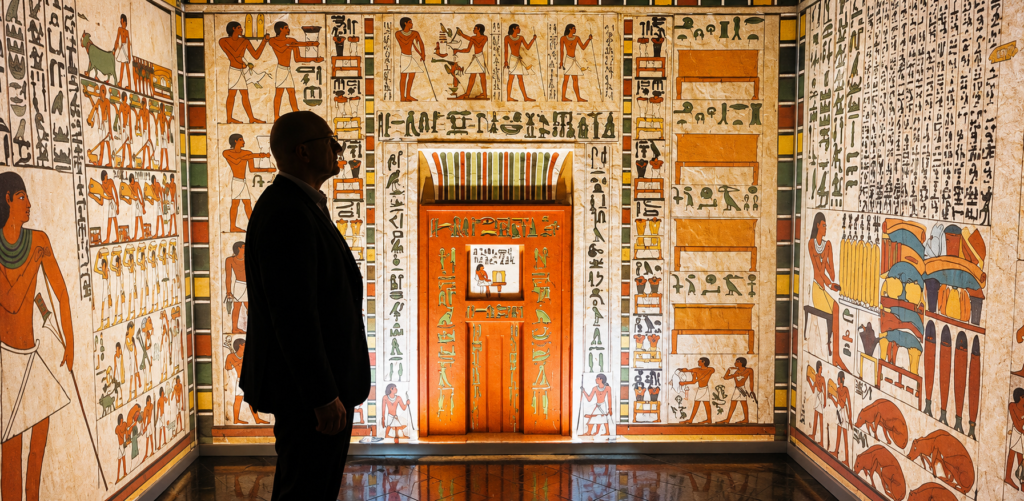
On 27 October 2026, the Museu Egipci de Barcelona opened a new immersive exhibition room, transforming an existing museum library space into a three-wall projection environment. The opening was also covered by La Vanguardia, one of Spain’s established news publications.
The installation was carried out by Clark, with technical consultancy provided by imaginArt’s engineering department during the project proposal stage.
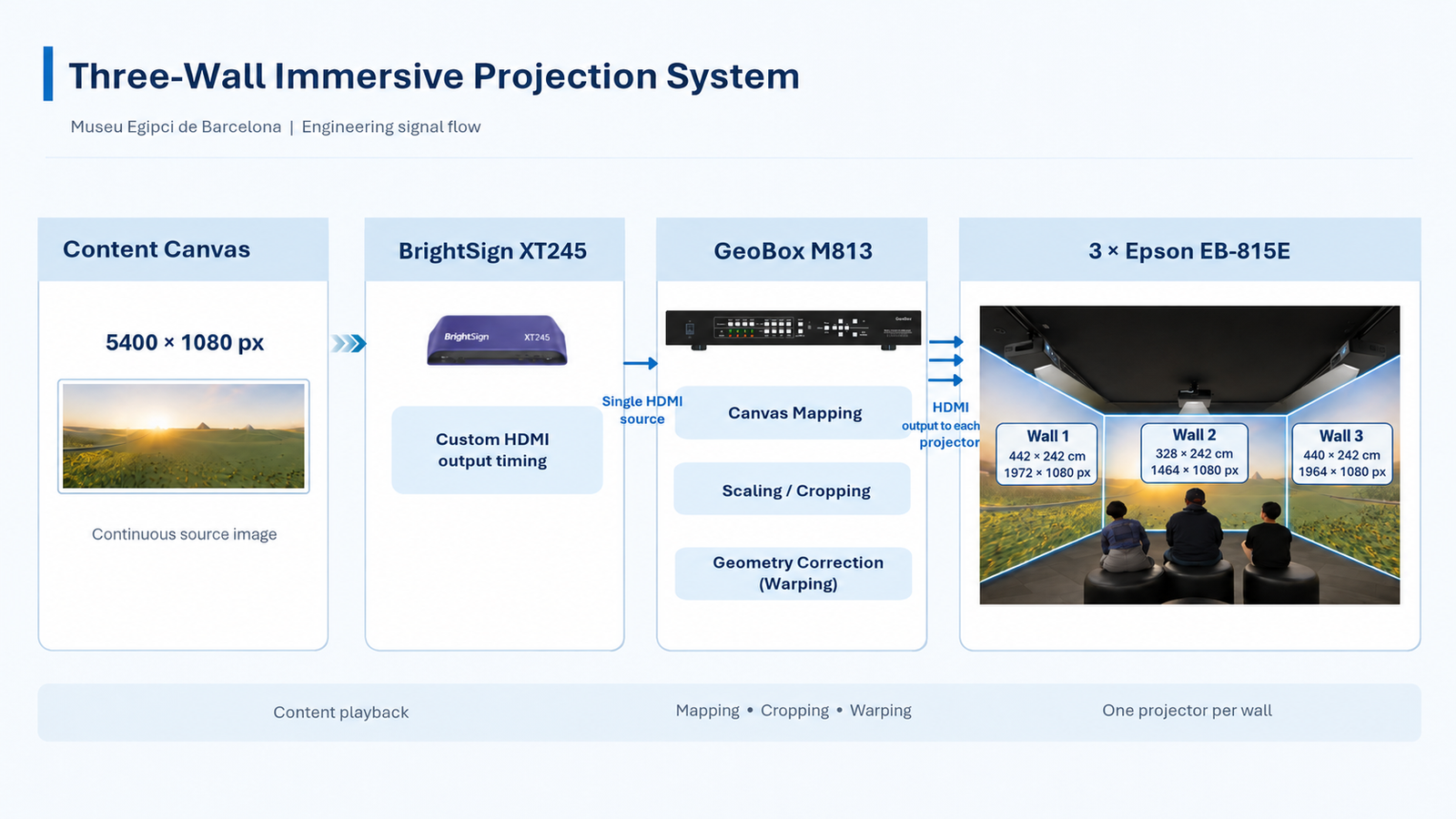
The system uses three Epson EB-815E ultra-short-throw (UST) projectors, one for each wall, together with a BrightSign XT245 media player and a GeoBox M813 video processor.
The engineering challenge was to achieve large projection coverage within limited installation space. The projectors had to operate beyond the manufacturer’s recommended installation conditions, making accurate geometry correction particularly important.
Maximizing Horizontal Source Resolution
The system uses a single BrightSign XT245 with a custom output resolution to feed all three projection channels.
Rather than relying on standard UHD timing, custom resolution allows more horizontal source pixels to be allocated within the HDMI 2.0 pixel-clock bandwidth limit of approximately 600 MHz.
For example, 7680 × 1200 at 60Hz using CVT Reduced Blanking provides 100% more horizontal pixels than standard 3840 × 2160 UHD. This is an illustrative example, not the confirmed output timing of this installation.
This approach allows the source pixel budget to be optimized for a wide, multi-projector canvas. GeoBox M813 accepts supported non-standard input resolutions without requiring additional custom EDID configuration.
For configuration details, see BrightSign Technical Documentation — Apply a Custom Resolution.
Canvas Mapping Across Three Walls
The three projection walls have different widths but share the same height. Based on their physical dimensions, the video content was prepared as a single, continuous 5400 × 1080-pixel canvas. GeoBox M813 uses its Video Wall and Overlap/Cropping functions to allocate the corresponding image regions to three independent projector outputs.
Content canvas resolution and HDMI output resolution serve different purposes and do not need to be identical. The content canvas defines the intended visual composition and proportions of the three walls, while HDMI output resolution determines how the video signal is transmitted within the available bandwidth.
As long as the content is prepared according to the physical wall proportions, GeoBox can scale and map the source image to the corresponding projection surfaces without introducing aspect-ratio distortion, even when the player’s output resolution has a different aspect ratio. The M813 also provides independent positioning and geometry correction for each projector to achieve accurate wall alignment.
Project: Museu Egipci de Barcelona — Iny, el explorador del faraón
System Integration, Installation & Deployment: Clark Tecnología y Soluciones (Clark)
Technical Consultancy: imaginArt Engineering Department
Equipment: BrightSign XT245 · GeoBox M813 · Epson EB-815E × 3
Opening: 27 October 2026
Independent Coverage: La Vanguardia — Museu Egipci de Barcelona
Geometry Correction Under Non-Standard UST Conditions
Ultra-short-throw projection is useful where installation depth is limited, but its steep projection angles make image geometry sensitive to projector positioning and wall conditions. With the Epson EB-815E projectors operating beyond their recommended installation conditions, geometry alignment became an important part of commissioning.
GeoBox M813 provides multi-point warping and fine geometry adjustments to correct image distortion and align the projected content with the wall boundaries. According to imaginArt, the M813’s warping capability proved particularly useful in completing the installation.
Projection Geometry and Signal management are managed from a Single Processing Platform
GeoBox M813 handles canvas mapping, scaling and geometry correction for all three projection channels. This provides a common configuration platform, allowing geometry adjustments to be made independently of the original playback content.
The configuration also adapts to changes in input resolution. For example, if the source changes from a custom 5760 × 1200 signal to standard 3840 × 2160 UHD, GeoBox automatically recalculates the corresponding image cropping values while preserving the configured output-side geometry and alignment. The content layout must still correspond to the intended wall mapping.
This reduces the need to reconfigure projection geometry when changing source formats and simplifies future system adjustments.
Installation Result and Engineering Takeaways
The completed installation demonstrates how custom source timing, multi-channel canvas mapping and hardware geometry correction can address the practical constraints of a three-wall UST projection system.
Three engineering considerations emerge from this project:
Source resolution: Allocate the available HDMI pixel bandwidth to provide sufficient horizontal resolution for a multi-wall canvas.
Canvas mapping: Distribute a single source into independently adjustable image regions corresponding to different wall dimensions.
Content and signal independence: Prepare content according to the physical display proportions, without requiring the HDMI output resolution to match the content canvas.
Geometry correction: Use hardware warping to accommodate non-standard projector installation conditions while maintaining a consistent configuration workflow.
The immersive room is also intended for continued use beyond the current exhibition, as reported by Tot Barcelona. This makes the ability to maintain projection geometry independently of playback content relevant to future exhibition changes.