
Technical Layer
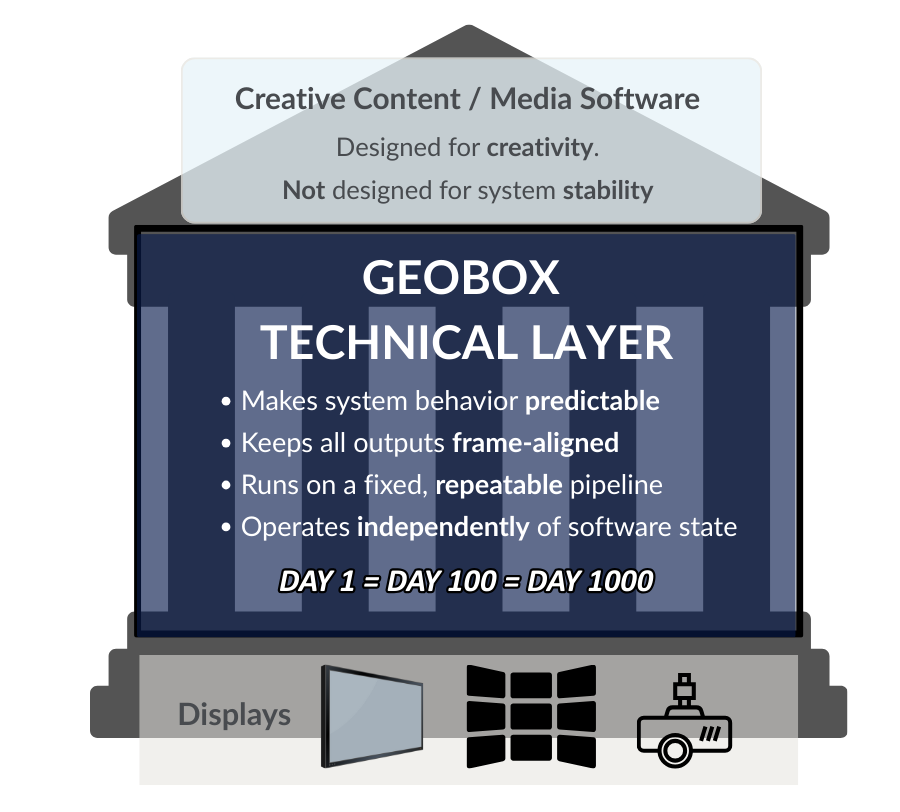
A Technical Layer makes Complex Display systems behave predictably
When resolution, screen shape, or 3D pipelines get complicated, device-level features and PC/GPU execution context stop being reliable. A technical layer separates display orchestration from compute so the system stays stable.
- Stable timing and sync
- System-level geometry behavior
- Less maintenance risk
Authored by Visual Displays Ltd., GeoBox’s UK partner with extensive field experience in immersive and 3D display systems, this document examines what a technical layer guarantees in complex display environments.
What we mean by a “Technical Layer”
- A technical layer is a dedicated system component that enforces display behavior as a stable contract.
- It sits between sources and displays to handle timing, mapping, and multi-output behavior consistently.
- This reduces dependency on OS state, GPU load, and application complexity.
Core Responsibility: Output-Side Image Processing
The Technical Layer is not a generic signal-flow concept. It is not AV-over-IP transport, broadcast routing, or media server rendering.
In our knowledge structure, the Technical Layer mainly describes output-side image processing: the responsibility of preparing images after sources or content canvases exist, but before they reach the final display devices.
This includes display canvas composition, image slicing, output mapping, geometry, overlap handling, EDID control, output timing, synchronization, and non-compressed RGB 4:4:4 video output.
Read more: Output-Side Image Processing in Complex Display Systems
Why this matters more in 2026
- Systems are running heavier workloads (AI, real-time rendering, analytics).
- When compute and display orchestration share the same execution context, predictability is usually first to fail.
- A technical layer isolates display behavior so the wall stays stable even when compute gets stressed.
What we do vs what we don’t do
We assume system-level display responsibility
- output-side image processing
- display canvas composition
- multi-output mapping behavior
- geometry and overlap behavior
- EDID and output format control
- stable timing and synchronization
- RGB 4:4:4 image output where image detail must be preserved
We do not replace
- content creation tools
- media servers and playback workflows
- projection design services
- onsite integration engineering output formats
When a Technical Layer Becomes Essential
A technical layer is no longer optional when a system meets any of the following conditions:
- The number of displays continues to increase. Read: How Geometry & Overlap Are Implemented at the Technical Layer
- The system enters the 4K class or higher resolution tiers.
- High resolution LED walls. Read: How a deterministic technical layer adds stability to high resolution LED wall system.
- Stereo 3D technologies are involved. Read: Why 3D systems feel unstable even when specifications appear correct
- Long-term stable operation and consistent behavior are required
This is not about pushing technical limits. It is about whether the system can be trusted over time.
Real-World Architecture Validation
Some architectural requirements only become visible at scale. This analysis examines why FPGA-based processing is used in one of the world’s largest continuous digital art environments, not as a feature choice, but as a system-level necessity.
Read: Why FPGA-Based Processing Remains Essential in Large-Scale Digital Art Environments
From Product Thinking to System Architecture Thinking
Modern display systems are shifting from selecting products to defining responsibility. The technical layer plays a central role in this transition. Once this layer is properly understood, the logic of system design changes fundamentally.
Recommended Next Reading
Foundation reading:
- Output-Side Image Processing in Complex Display Systems
- Display Canvas Composition in Complex Display Systems
Application reading: