
Couche technique
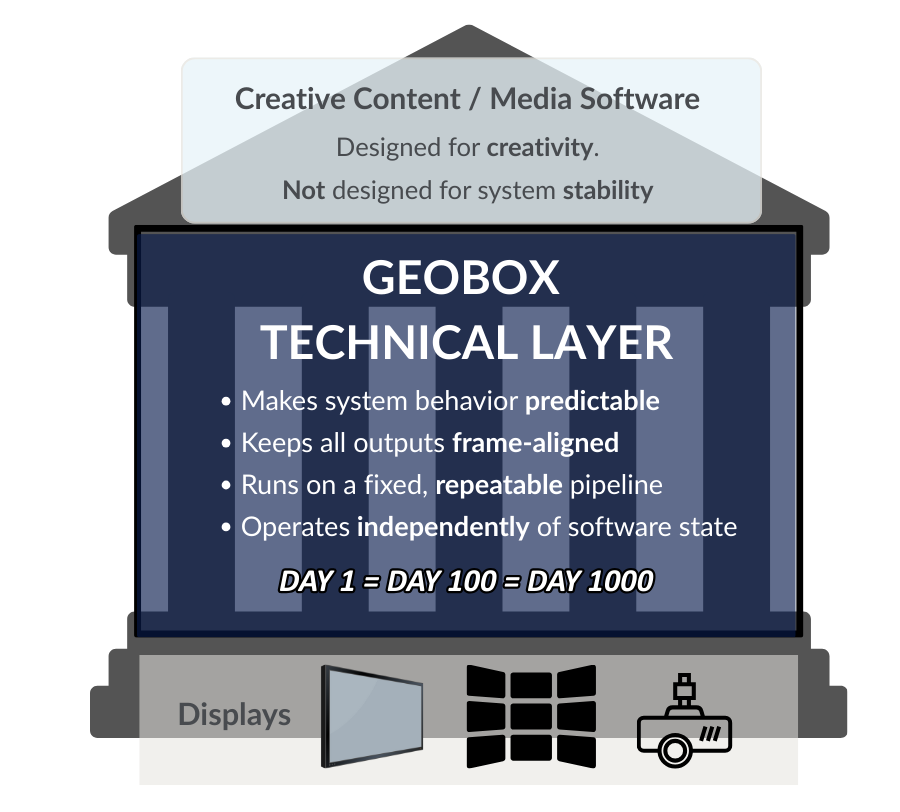
Une couche technique permet aux systèmes d'affichage complexes de se comporter de manière prévisible.
Lorsque la résolution, la forme de l'écran ou les pipelines 3D se compliquent, les fonctionnalités au niveau de l'appareil et le contexte d'exécution PC/GPU cessent d'être fiables. Une couche technique sépare l'orchestration de l'affichage du calcul afin que le système reste stable.
- Timing et synchronisation stables
- Comportement géométrique au niveau du système
- Moins de risques liés à la maintenance
Auteur Visual Displays Ltd.Ce document examine ce qu'une couche technique garantit dans des environnements d'affichage complexes. Il s'agit du partenaire britannique de GeoBox, qui possède une vaste expérience des systèmes d'affichage immersifs et 3D.
Ce que nous entendons par “couche technique”
- Une couche technique est un composant du système dédié qui applique le comportement d'affichage comme un contrat stable.
- Il se situe entre les sources et les écrans pour gérer de manière cohérente le timing, le mappage et le comportement multi-sorties.
- Cela réduit la dépendance à l'égard de l'état du système d'exploitation, la charge du GPU et la complexité de l'application.
Responsabilité principale : traitement d'images en sortie
La couche technique n'est pas un concept générique lié au flux de signaux. Il ne s'agit ni d'un transport AV sur IP, ni d'un routage de diffusion, ni d'un rendu par serveur multimédia.
Dans notre architecture conceptuelle, la couche technique décrit principalement le traitement d'image en aval : elle est chargée de préparer les images une fois que les sources ou les canevas de contenu existent, mais avant qu'elles n'atteignent les périphériques d'affichage finaux.
Cela inclut la composition de la zone d'affichage, le découpage des images, le mappage des sorties, la géométrie, la gestion des chevauchements, le contrôle EDID, la synchronisation des sorties, ainsi que la sortie vidéo RVB 4:4:4 non compressée.
En savoir plus : Traitement d'image en sortie dans les systèmes d'affichage complexes
Pourquoi cela sera-t-il plus important en 2026 ?
- Les systèmes exécutent des charges de travail plus lourdes (IA, rendu en temps réel, analyse).
- Lorsque le calcul et l'orchestration de l'affichage partagent le même contexte d'exécution, la prévisibilité est généralement la première à échouer.
- Une couche technique isole le comportement de l'affichage afin que le mur reste stable même lorsque le calcul est sollicité.
Ce que nous faisons et ce que nous ne faisons pas
Nous assumons la responsabilité de l'affichage au niveau du système
- traitement d'image en sortie
- composition de la zone d'affichage
- comportement de cartographie multi-sorties
- géométrie et comportement de chevauchement
- EDID et contrôle du format de sortie
- synchronisation et cadencement stables
- Sortie d'image RVB 4:4:4 où les détails de l'image doivent être préservés
Nous ne remplaçons pas
- outils de création de contenu
- les serveurs de médias et les flux de travail de lecture
- services de conception de projections
- intégration sur site formats de sortie de l'ingénierie
Quand une couche technique devient indispensable
Une couche technique n'est plus facultative lorsqu'un système remplit l'une des conditions suivantes :
- Le nombre d'écrans ne cesse d'augmenter. A lire : Comment la géométrie et le chevauchement sont mis en œuvre au niveau technique
- Le système entre dans la classe 4K ou dans des niveaux de résolution plus élevés.
- Murs LED haute résolution. Lire : Comment une couche technique déterministe ajoute de la stabilité à un système mural LED haute résolution.
- Les technologies 3D stéréoscopiques sont impliquées. Lire : Pourquoi les systèmes 3D sont-ils instables même si les spécifications semblent correctes ?
- Un fonctionnement stable à long terme et un comportement cohérent sont nécessaires
Il ne s'agit pas de repousser les limites techniques. Il s'agit de savoir si le système est fiable dans le temps.
Validation de l'architecture dans le monde réel
Certaines exigences architecturales ne deviennent visibles qu'à l'échelle. Cette analyse examine pourquoi le traitement FPGA est utilisé dans l'un des plus grands environnements d'art numérique continu au monde, non pas comme un choix de fonctionnalité, mais comme une nécessité au niveau du système.
De la réflexion sur le produit à la réflexion sur l'architecture du système
Les systèmes d'affichage modernes passent de la sélection des produits à définition de la responsabilité. La couche technique joue un rôle central dans cette transition. Une fois cette couche bien comprise, la logique de la conception du système change fondamentalement.
Prochaine lecture recommandée
Lectures de base :
- Traitement d'image en sortie dans les systèmes d'affichage complexes
- Composition des toiles d'affichage dans les systèmes d'affichage complexes
Lecture de la candidature :