
Custom Output Resolution and Timing Now Supported Across More GeoBox Product Lines
Most AV systems are built around standard video formats such as 1920×1080 or 3840×2160 at 50 or 60 Hz.
However, not every professional display system follows a standard 16:9 resolution or conventional video timing.
This is particularly relevant in dvLED installations, specialized projection systems, simulation environments and other applications where the display architecture determines the required resolution and timing.
GeoBox G901, G902 and G904 have already provided the ability to define custom output resolutions and timings. Since July 2026, this capability has also been extended to the M810, G400 and UD100 series.
This gives system integrators considerably more flexibility when matching GeoBox processing to the actual requirements of the display system.
Standard EDID Does Not Always Define the Complete System
In a conventional HDMI installation, the source normally reads the EDID information provided by the connected display and selects one of the supported video formats.
For most standard monitors, projectors and televisions, this works without any additional configuration.
Professional AV systems can be different.
The required output format may be determined by:
- the physical pixel canvas of a dvLED installation;
- the configuration of an LED controller;
- a projector that needs to operate at a specific refresh rate;
- an unusual display aspect ratio;
- a simulation or visualization system using a dedicated raster;
- or another downstream device requiring a specific video timing.
In these situations, relying only on conventional preset resolutions may unnecessarily restrict the system design.
Custom output resolution and timing allows the GeoBox output to be configured specifically for the downstream display architecture.
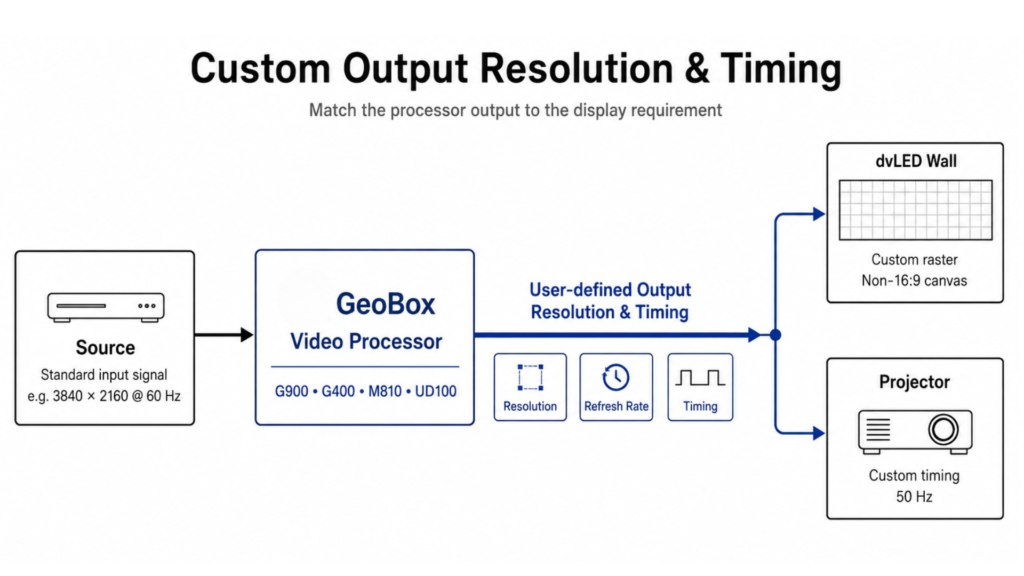
Example 1: Custom Resolution for dvLED
dvLED walls are one of the clearest examples.
Unlike a conventional 16:9 display, an LED wall can be constructed in almost any physical aspect ratio. Its actual pixel canvas depends on the LED module configuration and the way the receiving system is mapped.
For example, the required video raster may not correspond directly to standard formats such as:
1920×1080
2560×1440
3840×2160
Using a standard output format can therefore mean that part of the raster is unused, additional scaling is introduced, or the LED controller needs to perform extra processing.
When the LED processing system accepts an appropriate custom timing, the GeoBox output resolution can instead be defined to better correspond with the required system architecture.
This can make the interface between the video processor and the LED system more predictable and gives the system designer greater control over where scaling and image mapping take place.
Example 2: Projection Systems Requiring 50 Hz
Refresh rate is another common requirement.
A system designed around 50 Hz content or a projector installation that needs to operate at 50 Hz should ideally maintain the intended frame rate throughout the signal chain whenever possible.
If the required timing is not included among the standard output presets, a custom timing can be defined instead.
This is particularly useful in European broadcast-related environments, installations using 50 Hz source material, or projection systems where maintaining the required refresh rate is part of the overall system specification.
More Than Just a Custom Resolution
A custom output format is not simply a matter of entering a different horizontal and vertical pixel count.
A video signal is defined by its complete timing structure.
Depending on the application, this includes parameters related to:
- active horizontal and vertical pixels;
- refresh rate;
- horizontal and vertical timing;
- blanking intervals;
- pixel clock;
- and total signal bandwidth.
For this reason, custom output timing should always be configured according to the capabilities of both the GeoBox processor and the downstream equipment.
A display accepting a particular resolution does not automatically mean that every possible timing combination at that resolution will be supported.
GeoBox Product Support
Custom output resolution and timing was already available on:
From July 2026, the capability has also been extended to:
Série M810
Série G400
Série UD100
This makes custom output configuration available across a much broader range of GeoBox system architectures, from multi-projector processing to video wall, image cropping and high-resolution display applications.
Why This Matters in System Design
The objective is not to create unusual resolutions simply because the processor allows them.
The real benefit is architectural flexibility.
In a properly designed AV system, each processing stage should have a clearly defined responsibility.
If the display system requires a specific raster or timing, it may be preferable for the upstream processor to provide that signal directly rather than forcing the display controller to compensate for an unsuitable standard format.
This can be especially important when integrating:
- dvLED walls;
- unusual aspect-ratio displays;
- multi-projector systems;
- 50 Hz projection environments;
- simulation and visualization systems;
- specialized professional displays.
Custom output timing therefore becomes another engineering tool for matching the processing architecture to the actual display requirement.
Engineering Note
Before defining a custom output format, always verify three things:
- The required timing is within the output capability of the selected GeoBox model.
- The downstream display or processor explicitly supports the required resolution and timing.
- The complete signal bandwidth remains within the limits of the interface and connected equipment.
Custom timing provides additional flexibility, but it does not override the physical bandwidth or processing limitations of the devices in the signal chain.
For projects involving non-standard display resolutions, unusual refresh rates or specialized timing requirements, the output format can therefore be designed around the actual display architecture rather than being limited to conventional preset video formats.