
G112 Mini Edge Blending Processor
Compact Hardware Processing for Multi-Projector Blending
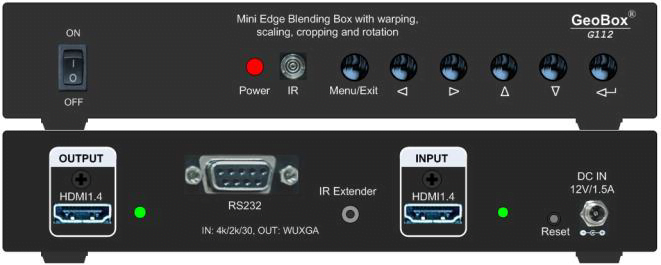
A compact single-channel processor for projector geometry correction, image distribution and edge blending.
Build flat, curved and corner projection systems without relying on PC-based geometry or blending software.
4K30 Input · WUXGA Output · 17×9 Geometry · Four-Side Edge Blending · Hardware-Based Processing
Full Projection Processing in a Small Hardware Processor
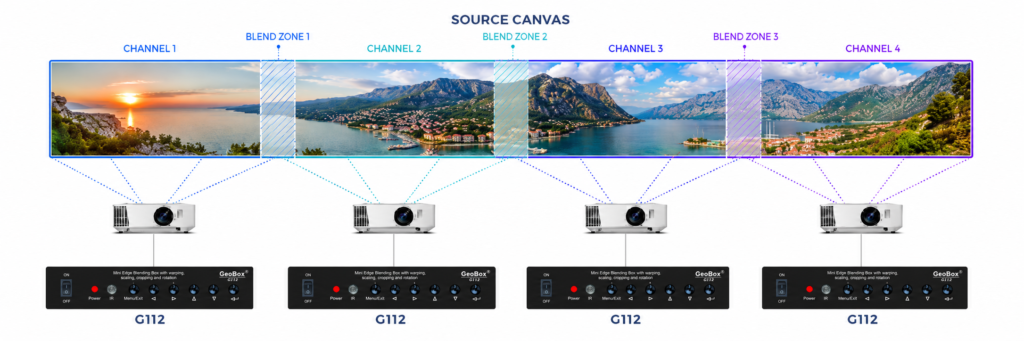
Divide one high-resolution source across multiple projectors and combine the projected images into one continuous panoramic canvas.
Best for: presentation spaces, exhibitions, experience centres and panoramic displays.
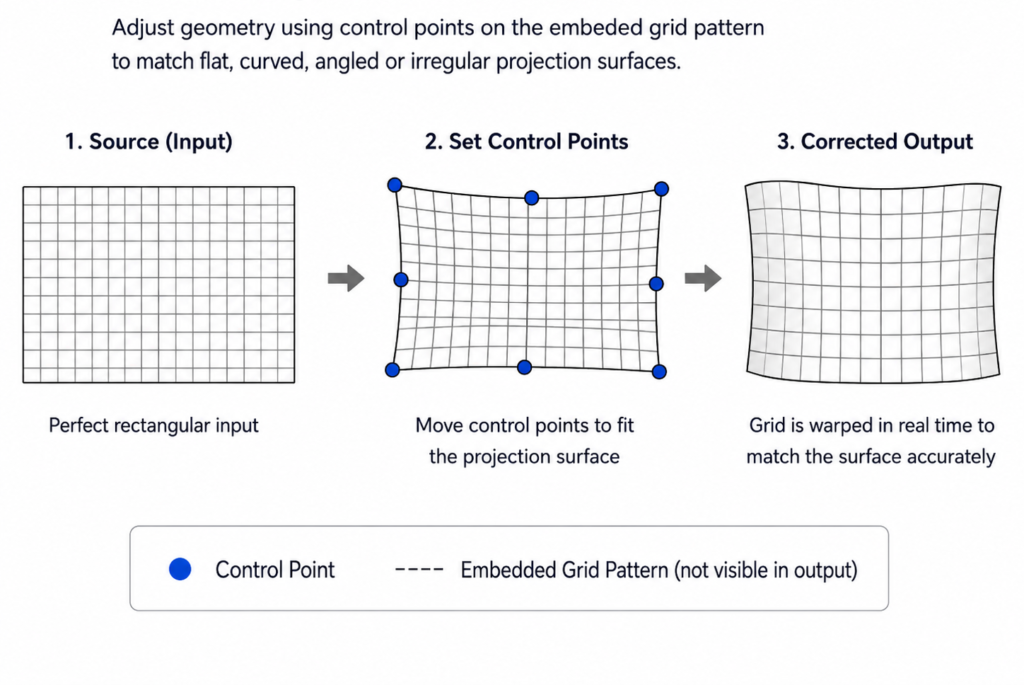
Correct projector geometry using up to 17×9 control points, together with linearity and corner-wall adjustment.
Best for: curved screens, short-throw projection and surfaces where projector positioning alone cannot produce accurate alignment.
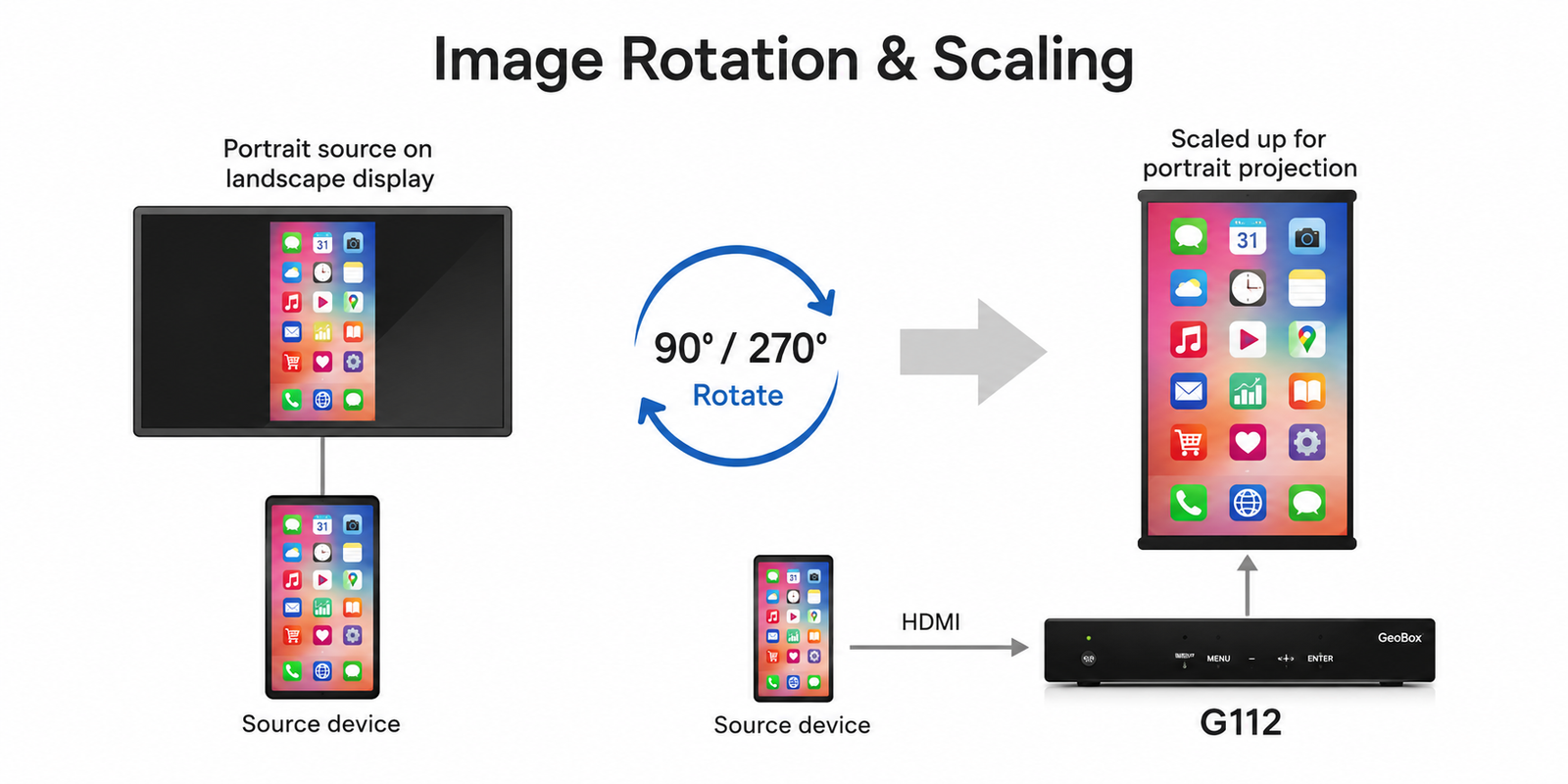
Rotate the image by 90° or 270° inside the processor, allowing projectors to be installed in portrait orientation without rotating the source content.
Best for: projection systems requiring increased vertical image resolution or unconventional projector orientation.
What G112 Does
From One Source Canvas to a Seamless Projected Image
G112 combines the processing functions required between the source and projector into one dedicated hardware device.
Each G112 controls one projector. In a multi-projector system, multiple units work together to crop the required section of the source, align projector geometry and create the overlap required for edge blending.
Assign the Correct Part of the Source to Each Projector
Each G112 selects and positions its assigned image section while defining the required overlap with adjacent projectors.
This allows one source canvas to be distributed across multiple projection channels without pre-splitting the content into separate files.
Align Projection Across Flat, Curved and Corner Surfaces
Correct image geometry directly inside the G112 before blending.
Geometry tools include:
- Four-corner adjustment
- Horizontal and vertical keystone correction
- Pincushion and barrel correction
- Up to 17×9 warp control points
- Linearity grid-line adjustment
- Corner-wall geometry adjustment
- Internal test grid with selectable grid size
This provides the control needed to align projected images where mechanical projector adjustment is not sufficient.
Create One Continuous Image Across Multiple Projectors
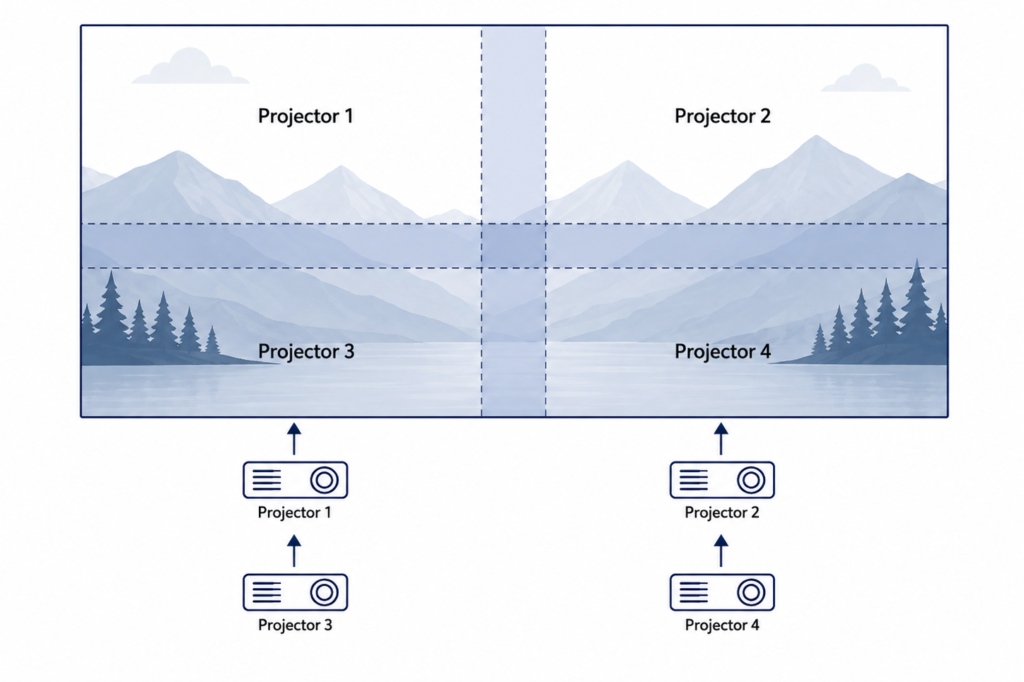
Edge blending can be applied independently to the left, right, top and bottom edges of the image.
Overlap regions can be adjusted up to:
- 1920 pixels horizontally
- 1200 pixels vertically
Independent RGB gamma adjustment is available within the blending region to help compensate for differences between adjacent projectors.
Rotate and Scale Content for Portrait Projection
G112 supports 90° and 270° image rotation together with image scaling, allowing landscape-format HDMI signals carrying portrait content to be adapted for portrait-oriented projection.
The image can be rotated and enlarged within the output canvas, making more effective use of the available projection area without changing the content orientation.
Hardware Processing Designed for Professional AV
Up to 4K30 Input
G112 accepts HDMI input up to 3840×2160 at 30 Hz with 4:4:4 chroma sampling.
The processor also supports non-VESA input timings and programmable EDID for integration with different source devices.
WUXGA / Full HD-Class Output
Each G112 provides one HDMI output supporting resolutions up to:
1920×1200 @ 60 Hz
or
2048×1080 @ 60 Hz
50 Hz output modes are also available for systems designed around 50 Hz content.
10-Bit Video Processing
10-bit processing, high-quality scaling and motion-adaptive de-interlacing maintain image quality through scaling and format conversion.
Frame-Synchronized Multi-Unit Operation
When several G112 processors are used together, Frame Sync locks their outputs to the incoming signal timing.
This helps maintain synchronized projector outputs across a multi-projector canvas and reduces the risk of visible frame tearing between adjacent channels.
Designed for Fixed, Repeatable AV Installations
Compact By Design
Its compact form factor (169x116x31mm, 0.53kg) allows the processor to be installed close to individual projectors or integrated into space-constrained AV systems.
The power consumption is as low as approx. 4.8W.
10 Configuration Profiles
Store up to ten complete system configurations and recall them using the IR remote controller, front-panel keypad or RS232 control.
Profiles can include image, output, geometry and other system settings.
Programmable EDID
Configure the source-facing EDID within a programmable range of:
Horizontal: 1024–3840 pixels
Vertical: 720–2400 pixels
This allows the source resolution to be better matched to the projection canvas.
Standalone Configuration
Geometry, blending and image settings can be configured directly through:
- IR remote controller
- Front-panel keypad
- RS232
No PC configuration application or WebGUI is required for normal commissioning.
RS232 Integration
G112 can be integrated with third-party AV control systems through RS232.
Individual Box IDs allow multiple processors to be addressed within the same installation.
OSD Lock
The on-screen menu can be locked after commissioning to reduce the risk of accidental changes to the installed configuration.
One Processing Channel per Projector
A G112 is installed in front of each projector.
For a multi-projector system, the source signal is distributed to multiple G112 processors using an HDMI distribution amplifier or splitter.
Each G112 then performs the processing required for its own projector.
Choose G112 When
- A compact hardware edge-blending processor is required
- Full HD or WUXGA projector output is sufficient
- The source signal is up to 4K30
- The installation uses a flat, curved or corner projection surface
- Configuration through remote controller or RS232 is sufficient
- A cost-efficient alternative to a larger multi-channel processing platform is preferred
- The system does not require PC-based geometry commissioning or network control
Consider Another GeoBox
Need More Advanced WUXGA Multi-Projector Processing?
M810 Series
Choose M810 when the project requires more advanced geometry control, black-level uplift, network and PC-based commissioning, multiple processor channels in one chassis or 4K60-class source connectivity.
Best for: mainstream immersive rooms, larger curved projection systems and professional multi-projector installations requiring more advanced calibration and control.
Explore M810→
Projectors Already Provide Geometry & Edge Blending?
G400 Series
Choose G400 when geometry correction and blending are already handled by the projectors and the requirement is primarily source cropping, scaling, distribution, synchronization or custom output timing.
Technical Specifications
Detailed signal, processing, control and mechanical specifications for system design and integration.
Video Input
Horizontal: 1024–3840 pixels
Vertical: 720–2400 pixels
Video Output
2048 × 1080 @ 60 Hz
- 1920 × 1080 @ 24 / 30 / 50 / 60 Hz
- 1920 × 1200 @ 30 / 60 Hz
- 2048 × 1080 @ 60 Hz
- Selected high-frame-rate formats up to 1280 × 800 @ 120 Hz
Geometry & Warping
- Four-corner adjustment
- Horizontal and vertical keystone correction
- Pincushion and barrel correction
- Grid-based warp adjustment
- Linearity adjustment
- Corner-wall adjustment
Edge Blending & Masking
Image Processing
Image Orientation
Synchronization & Latency
Control & Configuration
Mechanical & General
Technical Resources
RS232 Protocols
Command reference for third-party AV control integration.
View Downloads (shared the same code with M810)
Planning a Compact Multi-Projector System?
Share the screen dimensions, projector quantity, projector resolution, source format and intended overlap.
We can help determine whether G112 provides sufficient geometry and blending control or whether an M810 or UD100 architecture would be more appropriate for the project.