
Kōdai-ji Temple: Simplifying Seasonal Projection Mapping with BrightSign and GeoBox
How dedicated video processing separates content creation from projection geometry, making seasonal updates and on-site adjustments easier to manage.
Project Context: A Projection System for Changing Seasonal Content
At Kōdai-ji Temple in Kyoto, Japan, a six-projector mapping installation covers two areas: a traditional dry landscape garden and the temple gate.
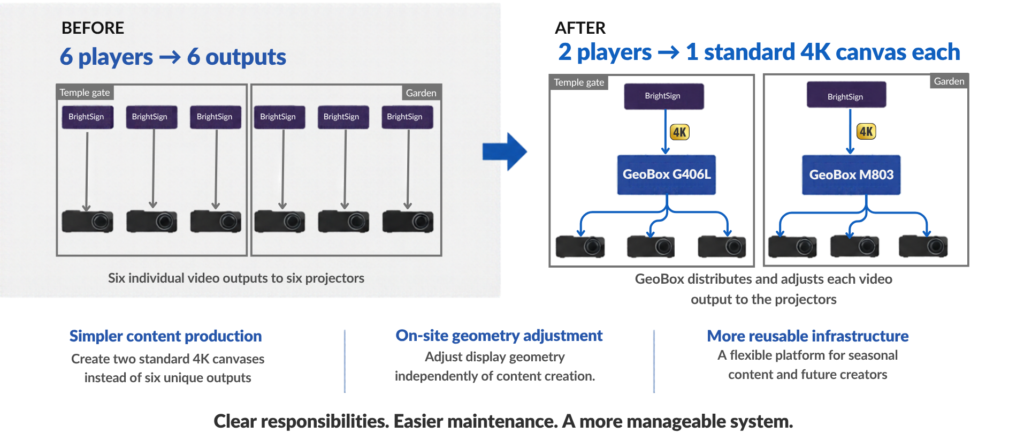
The installation, developed for a project proposed by Tlight Co., Ltd., originally used six BrightSign players, each connected to one projector.
While the system could deliver the required projection mapping, preparing six individual video outputs and managing player synchronization made content production more complicated.
The temple also presents different seasonal illumination programmes, sometimes involving different content creators. Each production previously required access to installation-specific geometry correction information.
Project: Kōdai-ji Temple, Kyoto, Japan
Application: Seasonal projection mapping
Project planning: Tlight Co., Ltd.
Equipment: 2 × BrightSign XT1144, GeoBox M803, GeoBox G406L, six projectors
Original case study: Japan Material Co., Ltd.
System Constraint: Content Preparation Was Tied to Projection Geometry
In the original workflow, changes to projection alignment could require content editing, re-rendering and repeated on-site testing.
This was particularly relevant to the dry landscape garden, where the physical surface could change slightly over time.
The challenge was therefore not simply to display the content, but to make the projection system easier to adjust and reuse without repeatedly modifying the original video files.
Technical Layer Responsibility: From Six Players to Two 4K Canvases
GeoBox was introduced between the BrightSign players and the projectors.
The revised architecture used two BrightSign XT1144 players, each delivering a standard 4K canvas to a GeoBox processor. The processors distributed the appropriate image regions to six projectors.
Importantly, the two projection areas required different processing responsibilities:
| Projection area | GeoBox model | Processing responsibility |
|---|---|---|
| Dry landscape garden | M803(*) | Image splitting, advanced geometry correction and edge blending |
| Temple gate | G406L(*) | Image splitting and overlap generation; geometry correction and blending handled by the projectors |
This allowed the project team to use dedicated geometry processing where necessary while retaining the projectors’ built-in capabilities where sufficient.
*The M803 is replaced by the M813. (click to view the model) The G406L is replaced by the G406. (click to view the model)
Observed Result: Easier Content Updates and On-Site Maintenance
According to the project team, the revised system reduced the work associated with content preparation and player synchronization.
Projection geometry could be adjusted directly through GeoBox without repeatedly editing and re-rendering the content.
Different production teams could also prepare new visuals using a standard 4K, 16:9 canvas, while the existing projection configuration remained available for reuse.
The installation demonstrates how separating content delivery from display-specific processing can simplify seasonal projection mapping and ongoing maintenance.
Related Architecture: BrightSign, GeoBox and Projector-Based Blending
The temple gate configuration follows the same architectural principle discussed in our article, GeoBox: The Missing Layer Between BrightSign and Epson Edge Blending.
When projectors already provide geometry correction and edge blending, GeoBox can supply the required image segmentation and overlap without duplicating those functions.
Where more complex geometry processing is necessary, a dedicated GeoBox warping and edge blending processor can assume those responsibilities.
Technical Summary
At Kōdai-ji Temple, six BrightSign players were replaced by two BrightSign XT1144 players feeding GeoBox M803 and G406L processors. The M803 handled complex geometry correction and edge blending for the garden, while the G406L generated overlapping image regions for the temple gate projectors. This architecture reduced content preparation and synchronization configuration work and allowed installation-specific adjustments to be managed independently from content production.