
GeoBox in 3D display systems
3D System Architecture
A Deterministic Technical Layer for Reliable 3D Display Systems
3D display systems fail less often because of image quality, and far more often because timing, synchronization, and format responsibility are unclear.
This page describes how GeoBox is used as a product architecture layer to make complex 3D systems predictable, repeatable, and stable across different display technologies.
What This Page Is (and Is Not)
This is not a product feature list.
This is not a tutorial for one specific 3D format.
This page defines where 3D responsibility lives in a professional AV system architecture.
GeoBox acts as a deterministic technical layer that sits between:
- unstable or mixed 3D sources
- and real-world display systems that must behave consistently over time
Why 3D Systems Become Unstable
In real projects, 3D instability rarely comes from the display itself.
It usually appears when:
- multiple 3D formats coexist (frame-packed, side-by-side, dual-stream, etc.)
- 3D content must be shown on different display technologies
- systems are restarted, reconfigured, or maintained by different engineers over time
Typical symptoms include:
- eye mismatch after reboot
- inconsistent left/right mapping
- latency drift that causes discomfort
- systems that work during commissioning but fail months later
These are architecture problems, not calibration problems.
GeoBox as a 3D Product Architecture Layer
GeoBox is deployed as a fixed 3D processing layer inside the signal chain.
At this layer, GeoBox is responsible for:
- Deterministic 3D decoding
- Stable left/right eye mapping
- Frame-accurate synchronization across outputs
- Predictable latency behavior
Once configured, this layer does not change its behavior due to:
- software updates
- operating system state
- content playback variations
The result is a 3D system that behaves the same:
- on day 1
- after every restart
- after years of operation
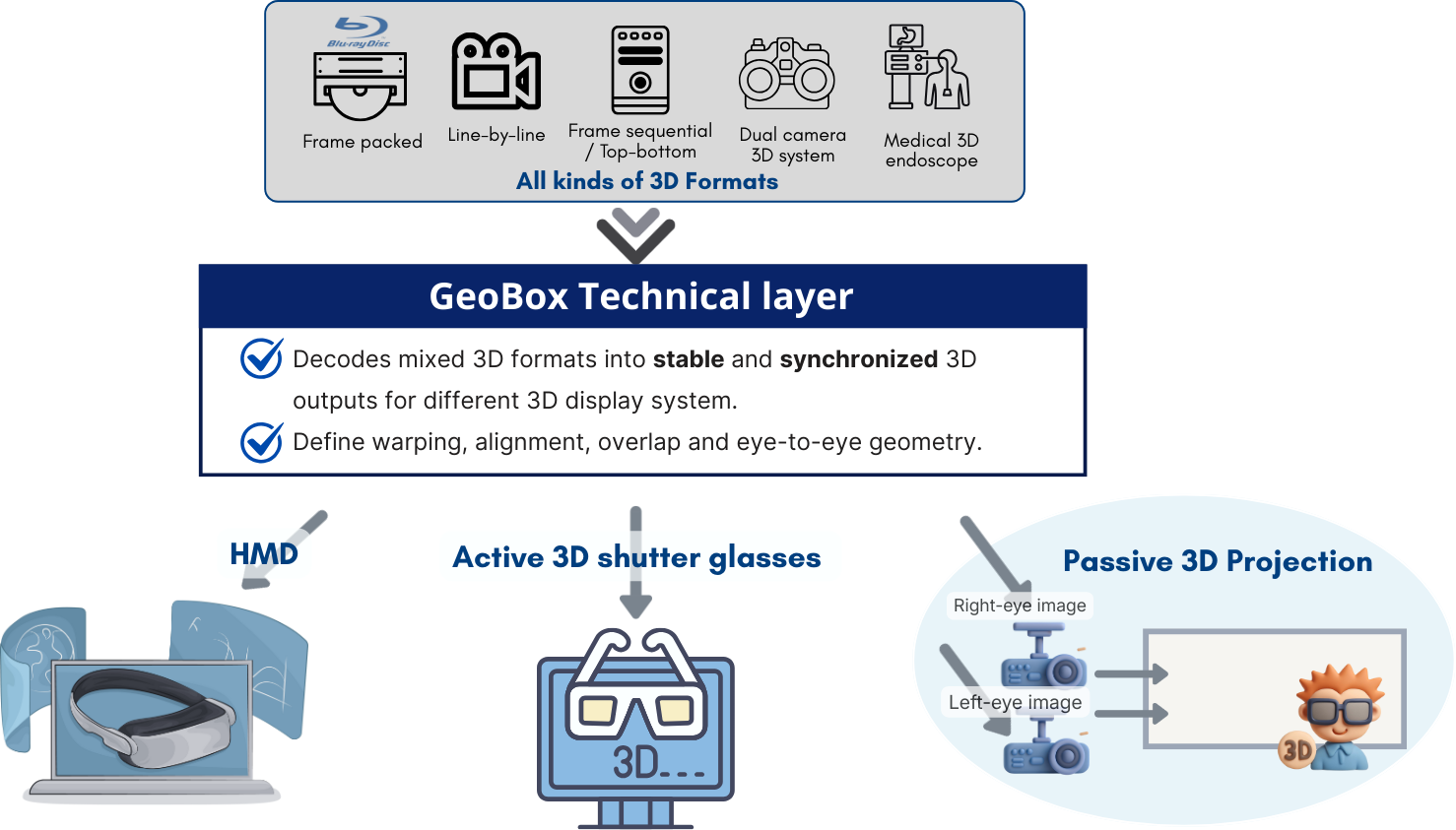
3D Display System Architecture
GeoBox 3D Technical Layer:
- 3D format normalization
- eye mapping enforcement
- geometry and overlap handling (if required)
By resolving 3D behavior before the signal reaches the display ecosystem,
everything downstream becomes simpler and more predictable
Display-Agnostic by Design
This architecture is intentionally display-agnostic.
The same 3D logic can feed:
- stacked projection systems
- dual-projector passive 3D
- active 3D displays
- glasses-free 3D panels
- LED-based 3D visualization environments
GeoBox does not care how the display creates depth.
It ensures that the signal entering the display system is correct and stable.
When This Architecture Becomes Necessary
This product architecture becomes essential when:
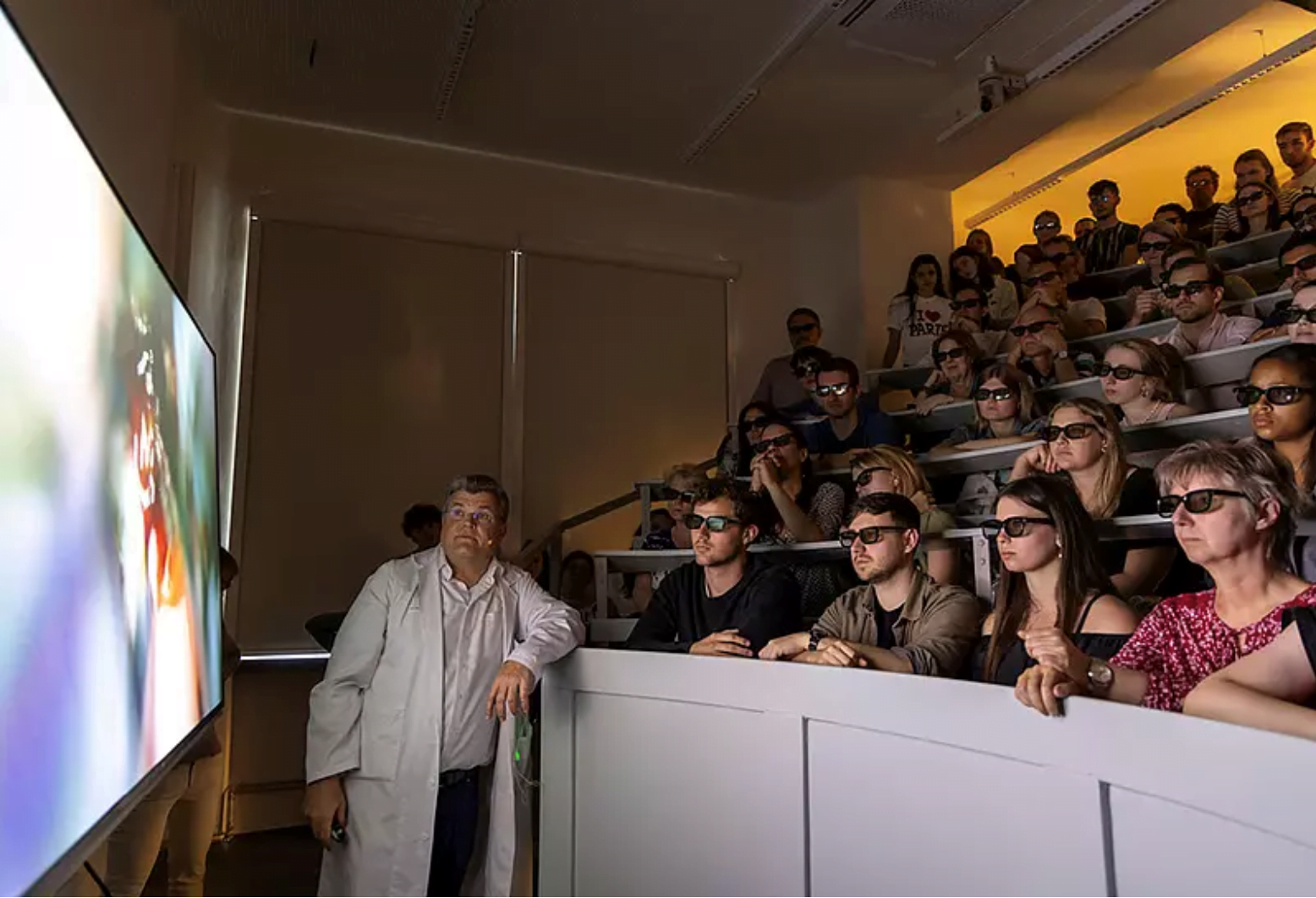
- 3D is shared by multiple viewers
- multiple display technologies must coexist
- system uptime and consistency matter more than flexibility
- the system must survive staff turnover and maintenance cycles
In these scenarios, relying on software state or manual reconfiguration is no longer viable.
View the Public 3D systems specifically designed for multiple viewers.
Not Replacing Creativity. Enforcing Predictability.
GeoBox does not replace:
- media servers
- creative software
- visualization tools
It defines a non-negotiable technical layer underneath them.
Creative systems remain flexible.
The technical layer remains stable.
That separation is what allows complex 3D systems to scale reliably.
Case Studies
GeoBox 3D-support models
| Model | G901 | UD101L | G902 | G406S | UD102 | g812 | ||
|---|---|---|---|---|---|---|---|---|
| Highlights | UHD No warp | UHD Warp | UHD No warp | WUXGA No warp | UHD Warp Edge blending | WUXGA Warp Edge blending | ||
| Input Ports | HDMI 2.0 x3, DP x 2 | HDMI 2.0 x3, DP x1 | HDMI 2.0 x5 | HDMI 2.0 x1 | HDMI 2.0 x6, DP x2 | HDMI 2.0 x2, DP x1, VGA x1 | ||
| Support 3D input formats | ||||||||
| Side by Side | V | V | V | V | V | V | ||
| Top/Bottom | V | V | V | V | V | V | ||
| Frame packed (BlueRay) | V | V | V | V | V | V | ||
| Frame Sequentiql (active 3D) | V | V | V | V | V | V | ||
| Line by Line (Line interleaved) | V | V | V | V | ||||
| Dual Camera | V | V | V | V | ||||
| Output Ports | HDMI 2.0x1 | HDMI 2.0x1 | HDMI 2.0x2 | HDMI 1.4x2 | HDMI 2.0x2 | HDMI 1.4 x 2 | ||
| Support 3D output formats | Side by Side, top/Bottom, Frame sequential, RH/LH eye frame, Line-by-Line | Side by Side, top/Bottom, Frame sequential, RH/LH eye frame | Side by Side, top/Bottom, Frame sequential, RH/LH eye, frame, Line-by-Line | RH/LH eye frame | Side by Side, Top/Bottom, Frame sequential, RH/LH eye frame | RH/LH eye frame | ||
| Loop out | HDMI 2.0x1 | HDMI 2.0x1 | HDMI 2.0x1 | HDMI 2.0x1 | HDMI 2.0x2 | HDMI 2.0x1 | ||
| Max. Input resolution | 4096x2160/60hz or 7680x2160/30hz (<600Mhz) | 4096x2160/60hz or 7680x2160/30hz (<600Mhz) | 4096x2160/60hz or 7680x2160/30hz (<600Mhz) | 4096x2160/60hz or 7680x120/30hz | 4096x2160/60hz or 7680x2160/30hz (<600Mhz) | 4096x2160/60hz or 7680x120/30hz | ||
| Max. output resolution | Programmable output resolution up to 4k2k/60, 8k/2k/30 (600Mhz) | 4096x2160@60hz | Programmable output resolution up to 4k2k/60, 8k/2k/30 (600Mhz) | 1920x1200@60hz | 4096x2160@60hz | 1920x1200@60hz | ||
| Max. output refresh rate | selectable refresh rate: 24/25/30/50/60/100/120Hz | FHD 240Hz | selectable refresh rate: 24/25/30/50/60/100/120Hz | Not selectable | FHD 240Hz | Not selectable | ||
| Geometric Correction (Warp) | NO | YES | NO | NO | YES | YES | ||
| 3D function | 1. Passive 3D: Decode 3D input signal into RH/LH eye frame output for passive 3D display. 2. 3D format conversion: Convert 3D input signal into Side by Side, Top/Bottom and frame sequential output signal for passive 3D and active 3D displays | 1. Passive 3D: Decode 3D input signal into RH/LH eye frame output for passive 3D display. 2. 3D format conversion: Convert 3D input signal into Side by Side, Top/Bottom and frame sequential output signal for passive 3D and active 3D displays. | 1. Passive 3D: Decode 3D input signal into RH/LH eye frame output for passive 3D display. 2. 3D format conversion: Convert 3D input signal into Side by Side, Top/Bottom and frame sequential output signal for passive 3D and active 3D displays | Passive 3D: Decode 3D input signal into RH/LH eye frame output for passive 3D display. | 1. Passive 3D: Decode 3D input signal into RH/LH eye frame output for passive 3D display. 2. 3D format conversion: Convert 3D input signal into Side by Side, Top/Bottom and frame sequential output signal for passive 3D and active 3D displays. | Passive 3D: Decode 3D input signal into RH/LH eye frame output for passive 3D display. |