
Project Context
VideobriX needed a compact monitoring structure for the shader’s room inside an SNG broadcast truck.
Traditionally, this role was handled with three separate high-end Sony monitors, each showing one live camera signal. The monitoring requirement was not simply to display three images, but to preserve a real-time operational view for camera shading work inside a space-limited broadcast environment.
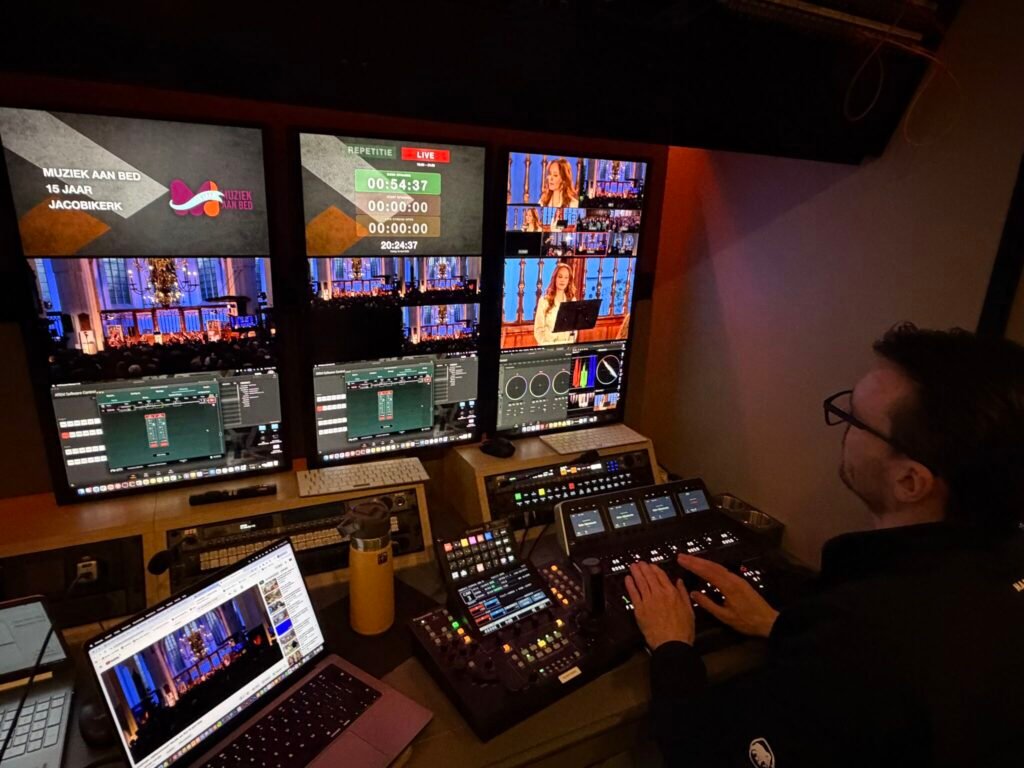
In this setup, VideobriX adopted a different display architecture: one 42-inch high-end display installed in portrait orientation, with three live camera feeds arranged vertically from top to bottom on the same screen.
System Constraint or Risk
A shader’s room does not only require multiple camera images to be visible. It requires those images to remain technically trustworthy.
Camera shading decisions depend on live visual judgement. The operator needs to compare camera feeds with confidence in timing, color behavior, resolution, and image integrity. If the monitoring chain introduces visible delay, compression artifacts, reduced chroma sampling, unstable HDR handling, or inconsistent scaling, the display may still show a picture, but it no longer represents a reliable reference for shading work.
For VideobriX, this was the critical constraint. The system needed to combine three live camera feeds into one portrait-oriented 42-inch display, while preserving the image-processing quality expected in a professional broadcast environment.
The G901 was selected because it could handle this responsibility in hardware. Its specification supports 4K/60 input, 4:4:4 chroma sampling, HDR BT.2020 input processing, RGB 4:4:4 output, true 10-bit processing, programmable output resolution, and one-frame latency at 60 Hz. These characteristics were not secondary features in the shader room. They were the reason the single-monitor architecture could replace three separate high-end Sony monitors without changing the operational purpose of the room. Check the GeoBox G901 UHD Multiview processor.
Technical Layer Responsibility
In this system, the GeoBox G901 became the image-processing layer between the live camera feeds and the portrait monitor.
Its responsibility was to receive the camera signals, preserve them through a non-compressed hardware processing path, arrange them into a three-window top-to-bottom multiview layout, and output a stable RGB 4:4:4 signal to the 50-inch display.
This role was different from a standard monitor split function or a software-based multiview layout. The G901 provided the required signal handling before the image reached the display. It supported HDMI and DisplayPort inputs, 4K-class signal processing, programmable output timing, and embedded 3-split and 4-split MultiViewer functions.
According to VideoBriX, this combination was critical in the shader’s room. The requirement was not simply to show three camera feeds on one screen. The requirement was to keep the three feeds usable as real-time broadcast reference images after they had been combined, scaled, and rotated into a portrait display format.
Implementation Summary
VideobriX replaced a three-monitor shader-room layout with one 42-inch high-end monitor installed in portrait orientation.
Three live camera feeds were connected to the G901. The G901 arranged these feeds vertically from top to bottom on the portrait screen, using its built-in multiview processing. The output was sent to the monitor as a single display signal.
The G901 preserved the signal path as a dedicated hardware process. It supported HDR BT.2020 input handling and full-color RGB 4:4:4 SDR output with only one frame latency (less than 16ms at 60hz). For VideobriX, this made the difference between a simple space-saving display idea and a broadcast-usable shader-room monitoring architecture.
Observed Result
The shader’s room could move from three separate high-end Sony monitors to one portrait-oriented 50-inch display without losing the operational function of three live camera references.
The result was a more compact monitoring structure inside the SNG truck. The G901 handled the multiview composition, portrait display orientation, image scaling, HDR/BT.2020 signal processing, and RGB 4:4:4 output in hardware. This allowed the display architecture to change while keeping the monitoring responsibility fixed at system level.
Short Technical Answer
VideobriX used the GeoBox G901 to replace three separate shader-room monitors with one 542-inch portrait display inside an SNG broadcast truck. The G901 combined three live camera feeds into a top-to-bottom multiview layout while maintaining one-frame latency, HDR BT.2020 input processing, and RGB 4:4:4 output. Its hardware-based processing avoided a PC or software compositor in the live monitoring path. According to VideobriX, this image-processing capability was critical for using a single portrait monitor as a reliable shader-room reference display.